The Madison blog
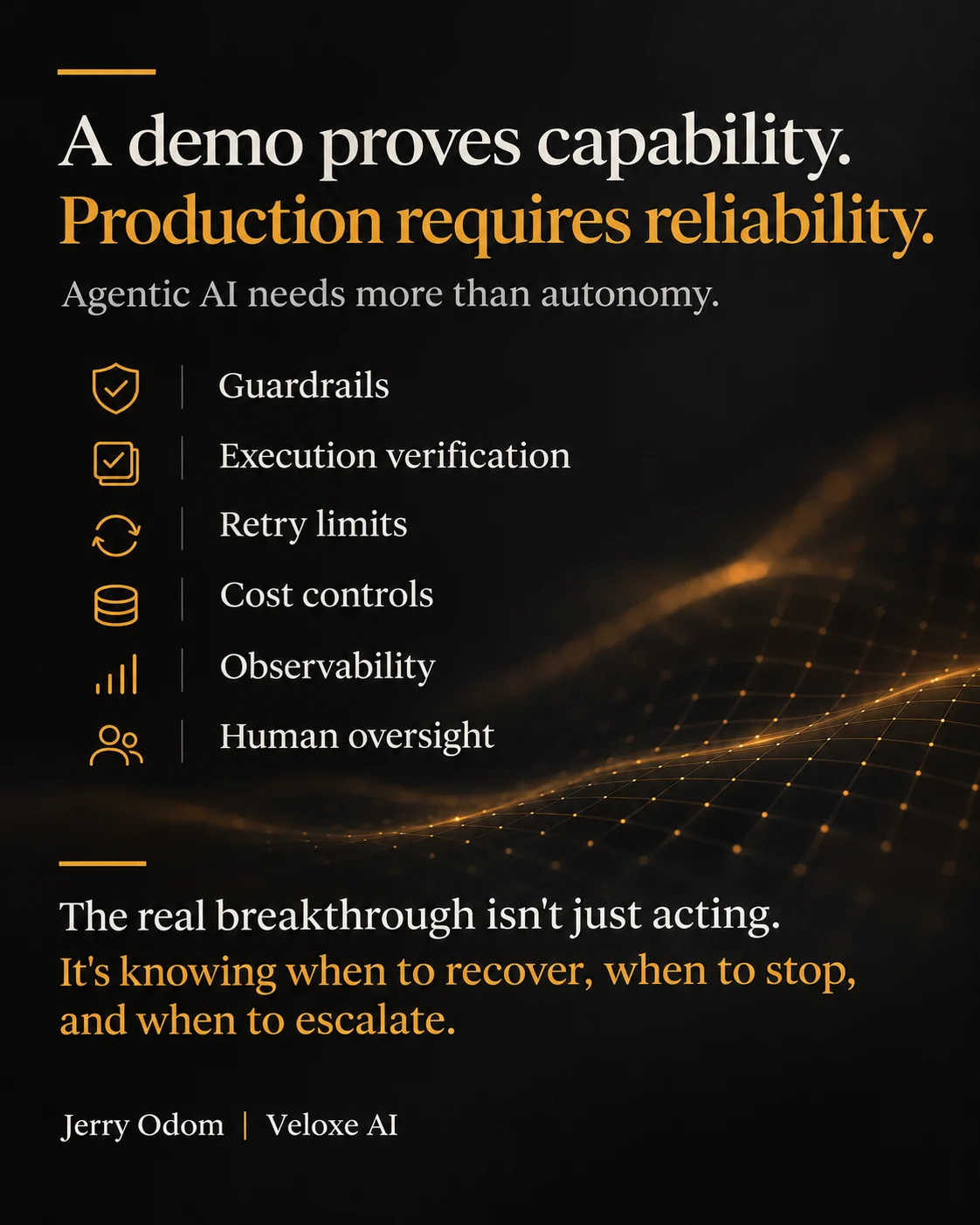
A demo proves capability. Production requires reliability.
Building an AI agent that does well in a demonstration is one thing. Engineering a system you can trust to run part of a real business is another.
I have spent more than 30 years building enterprise infrastructure and systems that could not afford to go down. The main thing that work taught me is simple.
What happens when something goes wrong matters just as much as what happens when everything goes right.
That is especially true of agentic AI, the kind that takes action instead of only giving advice. It is the problem we have been working on while building Madison, our operational AI system.
Finishing a task is not enough
An AI that completes a task once has shown you it can. Before it runs every day inside a business, it needs six more things:
- Guardrails and clear limits on what it is allowed to touch.
- Execution verification, so it confirms an action actually worked before it reports success.
- Retry limits and sensible recovery, so a stuck job does not loop forever.
- Cost controls, so automation can never run up a bill nobody approved.
- Observability: a record of what it decided, what it did and what happened.
- Human oversight whenever a decision carries real consequences.
A reliable system knows when it is failing
There is one more piece, and it matters as much as the six above. A dependable system should be able to tell when something is going wrong.
It should spot the problem, weigh its options, try to recover within the limits it was given, and check whether the fix worked. When it cannot solve the problem safely, it needs to stop and bring in a person.
That is the gap between automating tasks and building something you can actually leave running.
What this looks like in Madison
Here is how those ideas show up in practice, using Madison Retail as the example:
- Only the owner or a manager can change the store's website or flyers.
- A website change is drafted first, then confirmed, then published.
- If a flyer's artwork stalls, it is marked as failed and reported. It is not quietly retried forever.
- Artwork has a daily cap, and extra use stays off until the owner turns it on and sets a maximum.
- Every change is recorded, and undo steps back through the history one change at a time.
- Nothing posts to social media until the owner taps Approve.
You can see it working in our demo store.
Autonomy needs accountability
We are moving from AI that tells people what to do toward AI that does the work. That is a real step forward. But autonomy without accountability is not intelligence. It is risk.
The future of agentic AI will not belong to the most impressive demos. It will belong to the systems that deliver results reliably, safely and consistently, day after day. That is what we are building.
Common questions
What makes an AI agent ready for production?
Six controls: guardrails that set clear limits, verification that each action actually succeeded, retry limits, cost controls, a record of every action, and human approval before anything consequential goes out.
What should an AI agent do when it fails?
Notice the failure, try to recover within the limits it was given, check whether the fix worked, and if it cannot fix the problem safely, stop and tell a person.
Does Madison act without approval?
No. Anything that goes out into the world, a post, a send or a publish, waits for a person's OK.
See how she handles real work
Call Madison at (605) 608-9131 and ask her anything about your business, or walk through the demo store and watch the approvals for yourself.